When you sit down to pay taxes every year, you may wonder, “Why do we even pay taxes?” If you’re asking this question, you’re not alone. The tax history of the United States is long and complicated. Learn about why we pay taxes in this article.
Why do people get money back for taxes?
Tax refunds are issued by the federal or state government to reimburse taxpayers for any excess taxes they paid and/or had withheld from their paychecks throughout the year.
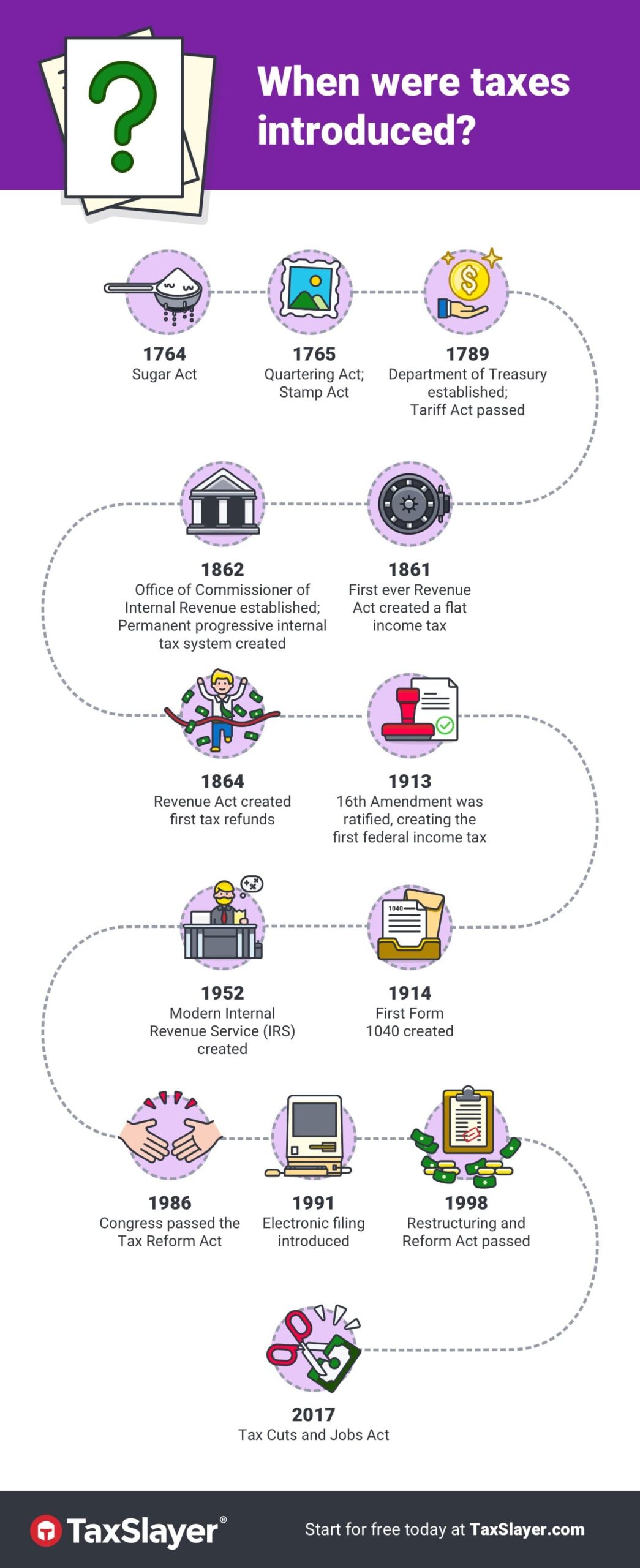
The Revenue Act of 1864 allowed the Office of Commissioner of Internal Revenue to refund taxes subject to current regulations. Thus, the first tax refund was created.
Who pays taxes?
Currently, any individual under age 65 who earns more than $13,850 (or $27,700 for married couples filing jointly) must pay taxes. Knowing your filing status is crucial, as it affects the minimum income threshold for tax obligations. Also, anyone who is self-employed or earns more than $600 from a side hustle must pay self-employed taxes.
What are the different types of taxes?
You might think you simply pay taxes once per year, and it is just one flat tax. However, there are many different types of taxes that you will pay throughout the year. Some may come out of your paycheck, while others may be added to goods or services you purchase.
Federal income tax
This is a tax paid directly to the federal government that depends on your income and your marital status.
State income tax
This is a tax paid directly to the state you reside in or work in. These taxes vary because each state gets to set its own rates. Some states do not have state income tax.
Local income tax
This tax is paid to the county or area that you live in.
Excise tax
This tax is paid on specific goods, like gas or liquor.
Estate tax
When someone passes away, they might leave their house or property to a beneficiary. The estate tax is imposed on the transferal of property.
Gift tax
If someone gives a gift that exceeds $17,000, it will be subject to additional tax. This tax is cumulative, so even if someone broke the gift up into multiple payments, anything over $17,000 gifted in a year will be taxed.
Sales tax
This is a tax paid on goods or services you purchase. Sales tax varies by state. In some cases, it may be beneficial to deduct sales taxes on your return.
Social Security and Medicare (FICA)
Also known as payroll tax, this tax comes out of each paycheck a traditional employee earns. The employee pays 6.2%, and the employer matches it for a total of 12.4% per paycheck. Self-employed individuals are responsible for paying this entire amount.
Alternative Minimum Tax (AMT)
If a taxpayer has a high income, they can use the AMT to set a limit their tax benefits. It ensures that a taxpayer pays a minimum amount of tax.
Sin tax
This is an additional tax on items that are viewed as harmful to the human body, like tobacco or alcohol.
Investment income tax
This tax applies to income from interest, dividends, capital gains, or other investments.
Capital gains tax
This tax is placed on the gains or losses of the sale of an asset such as a home.
Why do we have taxes?
In America, the money we pay in taxes is distributed to cover many different expenses. For example, our tax money is used to maintain the roads we drive on, to fund public libraries and parks, and to pay the salaries of government workers.
When were taxes introduced?
The U.S. has a long and complicated history with taxes. The British first introduced taxes to the United States with the Sugar Act of 1764, which was met with resistance. British taxation sparked events like the Boston Tea Party and led to the Revolutionary War. After gaining independence, the new nation initially resisted taxation but later allowed Congress to levy taxes through the Constitution, allowing states to support federal needs. The federal income tax, as we know it today, was officially enacted in 1913. Here’s a timeline of notable dates in tax history.